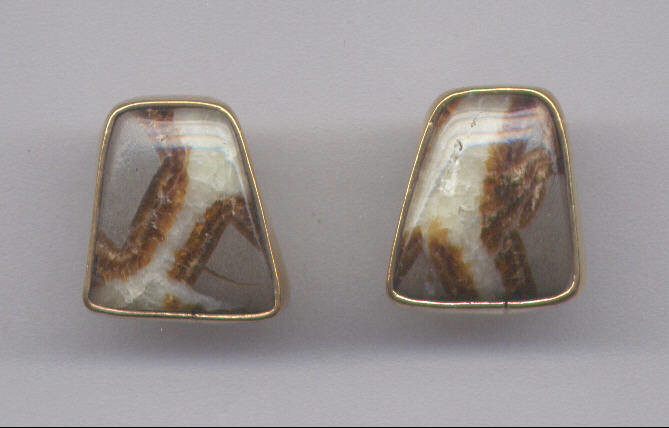
Pietersite & Vermeil Earrings
SKU ESW 075
$64.00
In stock
Product Details
Pietersite & Vermeil Earrings - Pietersite gemstone trapezoids set in vermeil bezels. The natural earthy color variegation of the pietersite is gray, brown and cream.
The earrings are approximately 19mm.
Pietersite was discovered by Sid Pieters in 1962 while he was prospecting some farmland in Namibia, Africa. The China form of pietersite is said to have been discovered in 1993, but did not come to market until 1997. This China pietersite exhibits slightly different color variations from Mr. Pieter's original mineral, but both are beautiful and are now universally recognized as pietersite.
The fibrous structure in pietersite has been folded, stressed, even fractured and/or broken apart via the Earth's geologic processes. The fibrous materials have then been reformed and naturally recemented together by quartz. Stones and crystals that go through this process are referred to as brecciated, creating a finished product with multiple colors, hues and superb chatoyancy.
While pietersite has the lovely chatoyancy of tiger eye, it is not found in continuously structured bands or fibers, more in swirls, swathes and fibrous (sometimes linear) segments. Thus the structure of the fibrous streaks in pietersite may appear rather chaotic, and can flow or exist in many directions side-by-side like bold paint strokes.
Colors include various blues, golds and reds, that may appear together or alone. Blue is the rarest color, followed by red. The blues range from a baby blue to dark midnight hue. Golds can be light to very deep and rich, sometimes having a reddish hue. All fibrous color variations will have a superb and striking chatoyancy, the bright and subtly changing shimmer of color that moves along the surface of a gemstone as it is viewed from varying angles.
The earrings are approximately 19mm.
Pietersite was discovered by Sid Pieters in 1962 while he was prospecting some farmland in Namibia, Africa. The China form of pietersite is said to have been discovered in 1993, but did not come to market until 1997. This China pietersite exhibits slightly different color variations from Mr. Pieter's original mineral, but both are beautiful and are now universally recognized as pietersite.
The fibrous structure in pietersite has been folded, stressed, even fractured and/or broken apart via the Earth's geologic processes. The fibrous materials have then been reformed and naturally recemented together by quartz. Stones and crystals that go through this process are referred to as brecciated, creating a finished product with multiple colors, hues and superb chatoyancy.
While pietersite has the lovely chatoyancy of tiger eye, it is not found in continuously structured bands or fibers, more in swirls, swathes and fibrous (sometimes linear) segments. Thus the structure of the fibrous streaks in pietersite may appear rather chaotic, and can flow or exist in many directions side-by-side like bold paint strokes.
Colors include various blues, golds and reds, that may appear together or alone. Blue is the rarest color, followed by red. The blues range from a baby blue to dark midnight hue. Golds can be light to very deep and rich, sometimes having a reddish hue. All fibrous color variations will have a superb and striking chatoyancy, the bright and subtly changing shimmer of color that moves along the surface of a gemstone as it is viewed from varying angles.
Save this product for later
Pietersite & Vermeil Earrings